

| Contact Us |
| Name:colin |
| Email:colin@xhhjtech.com |
| T e l:+86 18602602237 |
Powder Conveying Equipment Comparison: Which Method Suits Your Production Line Best?
Powder conveying serves as the "production line vascular system" connecting various processing stages, from feeding to pretreatment, mixing, and packaging, the flow of powder materials relies on conveying equipment. Currently, the mainstream industrial powder conveying methods primarily include screw conveying, pneumatic conveying, and vacuum conveying. These methods differ fundamentally in their principles and are suited to vastly different application scenarios.
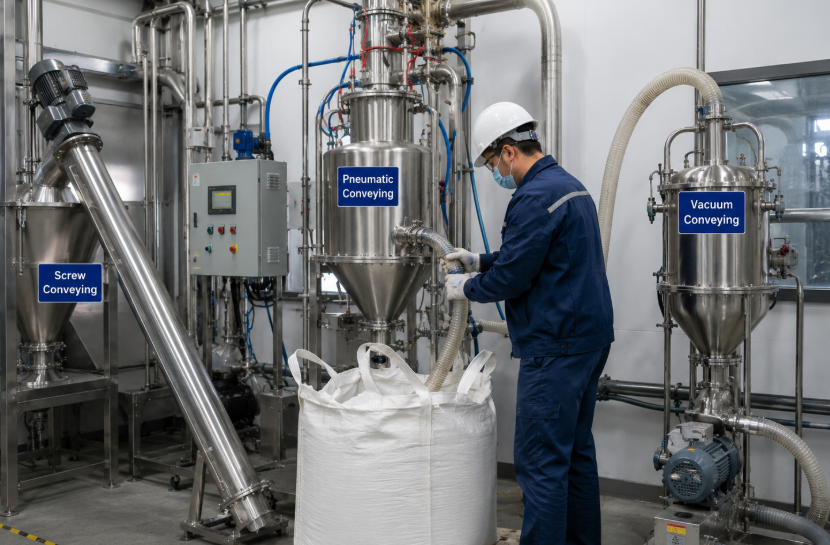
Screw conveying is the most classic mechanical conveying method, relying on a rotating screw blade to push powder along a pipe.
It features a simple structure, low cost, and stable, controllable conveying capacity, making it suitable for short-distance, horizontal, or slightly inclined conveying scenarios, such as material transfer from a feed hopper to a pulverizer. However, its drawbacks are evident: friction between the blade and the pipe wall causes wear, making it unsuitable for hard or highly abrasive powders; long-distance conveying incurs high energy consumption; and residual material tends to accumulate inside the pipe, making cleaning difficult and rendering it less ideal for frequent product changeovers.
Pneumatic conveying utilizes air flow energy to transport powder in a direction along the air stream within a closed pipeline. It is divided into positive-pressure conveying and negative-pressure conveying.
Positive-pressure pneumatic conveying is suitable for long-distance, high-capacity scenarios, such as transferring powder from a warehouse to a production workshop within a plant, with conveying distances reaching up to hundreds of meters. Negative-pressure pneumatic conveying is suitable for multi-point suction and centralized conveying, where dust is less likely to escape. The advantages of pneumatic conveying include flexible pipeline layout, adaptability to complex workshop configurations, and a fully enclosed, dust-free process. However, it imposes requirements on particle size and density; overly fine or light powders tend to stratify within the pipeline, and brittle materials are prone to breakage due to collisions. Overall energy consumption is relatively high.
Vacuum conveying is a subcategory of negative-pressure pneumatic conveying and is the mainstream choice for the fine chemical, pharmaceutical, and food industries.
It uses a vacuum pump to generate high negative pressure, drawing powder into the conveying pipe. The powder is then separated from the air via a cyclone separator or filter element and ultimately discharged into downstream equipment. Vacuum conveying offers a fully enclosed process, high cleanliness, compact equipment size, and flexible installation, making it highly suitable for short-distance, high-precision inter-process transfer. However, its conveying distance and capacity are limited and it is not ideal for high-capacity, long-distance transport.
Brief summary: For short distances, small capacities, and low-abrasion materials, choose screw conveying; for long distances, large capacities, and stable material properties, choose pneumatic conveying; for high cleanliness requirements and short-distance process transfer, choose vacuum conveying.


