

| Contact Us |
| Name:colin |
| Email:colin@xhhjtech.com |
| T e l:+86 18602602237 |
Powder Pretreatment: Why Is It the "Invisible Cornerstone" of the Processing Flow?
Many focus on core processes like mixing and packaging in powder processing, often overlooking the importance of pretreatment stages. In reality, powder pretreatment is the foundation for final product quality. Raw materials must undergo a series of pretreatment steps before they can enter subsequent processing.
Simply put, powder pretreatment involves"organizing and optimizing" raw materials to meet the requirements of downstream processes. The core pretreatment operations primarily include pulverizing, sieving, de-impingand drying.
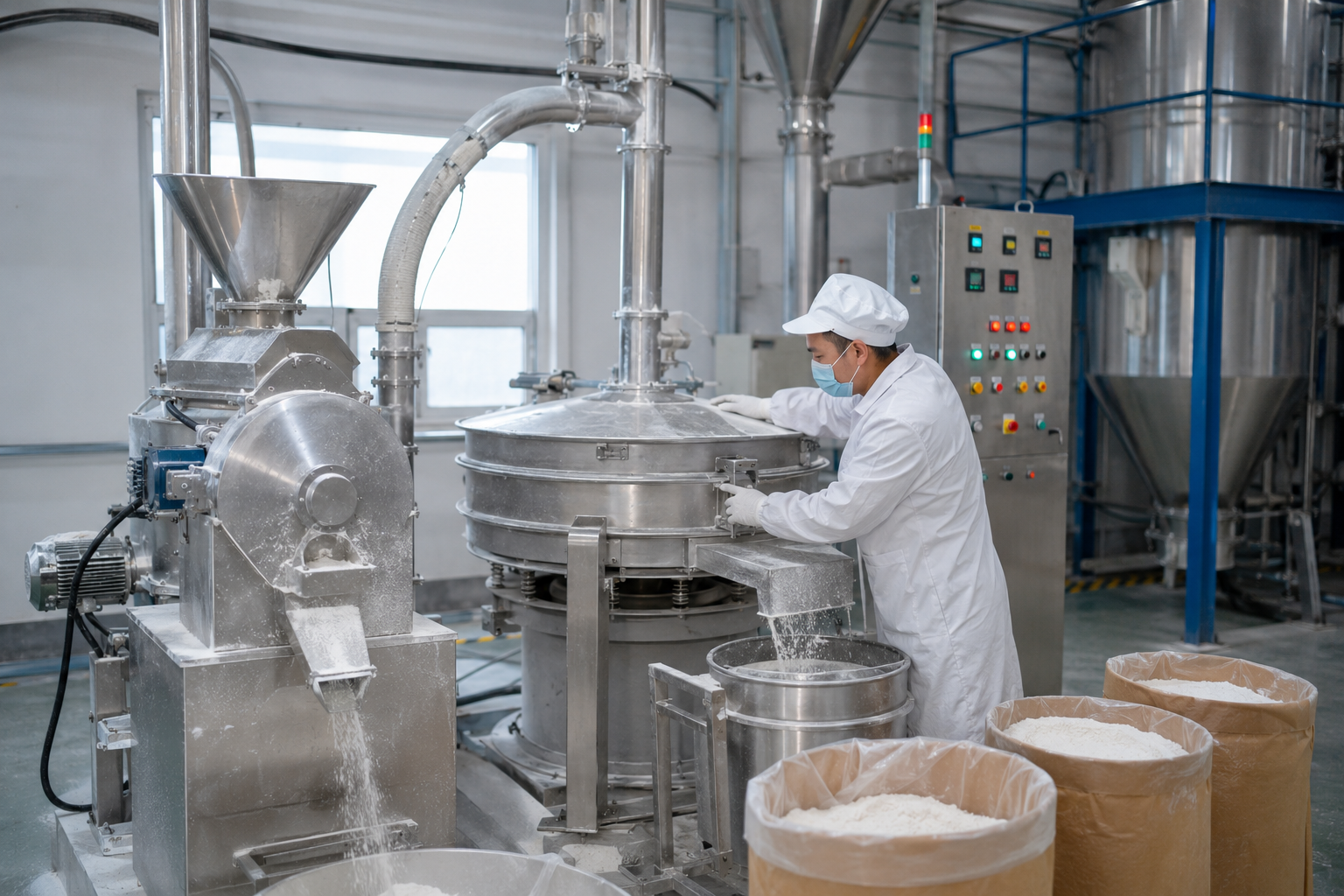
Pulverizing is the most fundamental pretreatment operation.Many raw materials are supplied as large particles or lumps (e.g., herbal medicines, chemical crystals, cereal grains) and cannot be directly mixed or packaged. They must be ground and milled to achieve the target particle size. Depending on the required fineness, equipment ranges from coarse crushers, universal pulverizers, to jet mills. Coarse crushing reduces materials to the millimeter range, while ultra-fine jet milling can achieve micron or even sub-micron levels. Pulverizing not only standardizes particle size but also enhances material solubility and mixing uniformity, directly impacting final product performance.
Sieving is a classification step that complements pulverization.The particle size of pulverized material is not uniform. Sieving equipment such as vibrating screens and rotary vibrating screens is used to classify particles by size, removing oversized particles and ensuring uniform particle size distribution. Sieving also provides preliminary de-imping by screening out large impurities. For industries with strict particle size requirements, such as pharmaceuticals and powder coatings, sieving accuracy directly determines product qualification rates.
De-imping is a critical step for ensuring powder purity.Raw materials can inadvertently pick up contaminants like metal shavings, hair, and grit during production, transportation, and feeding. If these contaminants enter downstream processes, they not only compromise product quality but can also damage equipment. Common de-imping equipment includes magnetic separators (e.g., permanent magnetic drums), metal detectors, and vibrating screens with impurity removal functions. Metal impurity removal is particularly mandatory in the food, pharmaceutical, and lithium battery industries, using strong magnetic bars or metal detection systems to precisely eliminate metal contaminants and ensure product safety.
Drying targets powders with excessive moisture content.Many powders are hygroscopic; high moisture levels can cause caking and poor flowability, affecting subsequent mixing and packaging accuracy and potentially leading to mold growth and spoilage during storage. Equipment such as vacuum dryers and fluidized bed dryers is used to remove excess moisture, maintaining stable flowability and storage stability.
Pretreatment processes essentially create a "foundation" for the powder. A well-prepared foundation ensures that subsequent mixing and packaging proceed smoothly, guaranteeing the quality of the final product.


