

| Contact Us |
| Name:colin |
| Email:colin@xhhjtech.com |
| T e l:+86 18602602237 |
Small-Dose Powder Filling Difficult? These Solutions Address Precision Challenges
In powder filling, small-dose filling (0.1g-10g) is widely recognized as a challenge. The smaller the dose, the harder it is to control accuracy; subtle factors like powder caking or air currents can cause weight deviations to exceed limits. Optimizing at the equipment, process, and material levels can achieve high-precision, stable filling for small doses.
The core challenges of small-dose filling are threefold: first, poor powder flowability leading to unstable discharge and inconsistent fill weights; second, dust and adhesion causing powder to stick to nozzles and piping, resulting in underfilled containers; third, the small dose amplifies the impact of metering mechanism tolerances, making precision control difficult.
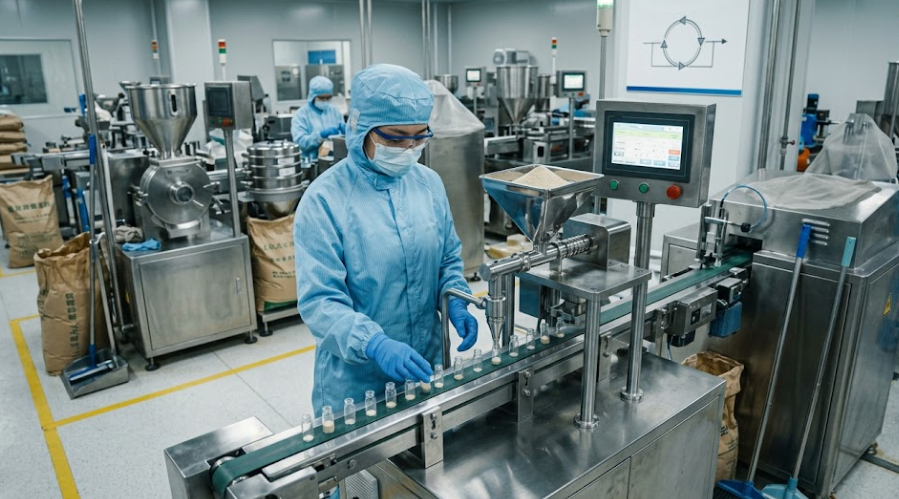
Equipment Level: Selecting High-Precision, Specialized Filling Equipment
Standard large-screw fillers lack the precision for small doses. Specialized small-dose screw fillers feature precision screws with smaller diameters and leads, delivering minimal volume per rotation. Paired with servo motors for precise angular control, they can accurately meter fractions of a gram.
For demanding pharmaceutical-grade 0.1g powder filling, a combination approach using "screw pre-fill + weigh-scale trim" can be employed: a screw quickly adds ~90% of the target weight, followed by a micro-feed mechanism for precise final adjustment, balancing speed and accuracy to achieve tolerances within ±0.005g.
To address adhesion and dust issues, contact parts require mirror polishing to reduce surface roughness and adhesion; for ultra-fine powders, PTFE coatings can be applied to further reduce sticking. Additionally, using telescopic, thin-diameter nozzles that discharge deep into the container, combined with micro negative-pressure dust collection, minimizes dust without compromising filling accuracy.
Material and Process Level: Pretreatment is Key to Stability
Often, poor filling accuracy is not due to equipment but to poor powder flowability. Hygroscopic caking or ultra-fine agglomerates cause irregular feed rates, making precision difficult.
Pretreatment before filling is essential: break up agglomerates via pulverizing and sieving to ensure loose, uniform powder; dry materials with high moisture content to reduce hygroscopicity and improve flow; for extremely poor-flowing ultra-fine powders, consider adding a trace amount of glidant (e.g., fumed silica) to enhance flowability. Stable powder flowability directly translates to improved filling precision.
Environment and Maintenance: Details Determine Long-Term Stability
Temperature and humidity fluctuations affect powder moisture content and flowability; materials are particularly prone to hygroscopic caking during humid seasons like the plum rain period. It is recommended to maintain a controlled environment for small-dose filling workshops: 20-25°C temperature and 40%-60% relative humidity to minimize environmental impact on material properties. Avoid excessive air currents in the workshop that could interfere with powder flow and weighing accuracy.
Daily maintenance is crucial: thoroughly clean hoppers, screws, and nozzles after each production run to prevent residual powder caking from affecting subsequent accuracy. Regularly inspect screw wear; increased clearance due to wear leads to unstable discharge and requires timely replacement of worn parts.


