

| Contact Us |
| Name:colin |
| Email:colin@xhhjtech.com |
| T e l:+86 18602602237 |
Double-Shaft Gravity-Free Mixer Not Meeting Uniformity Standards? The Problem Is in These Three Areas
When a double-shaft paddle mixer fails uniformity testing, in most cases the equipment itself is not faulty. The issue usually comes from operating details. The three most common causes are listed below. Checking each one can solve most problems.
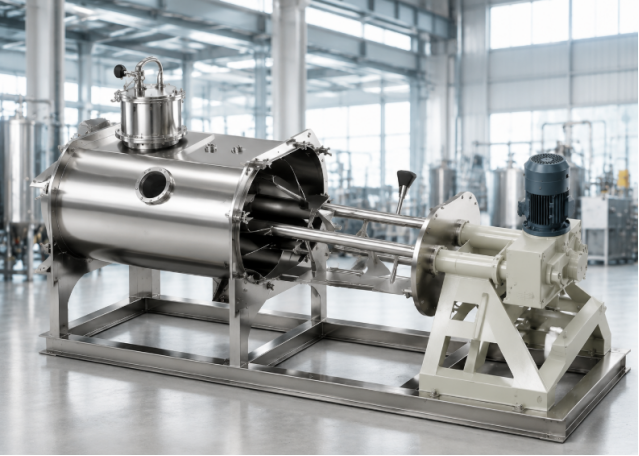
1. Incorrect fill level
Material must be filled just up to the centerline of the two agitator shafts. If the fill is too low, the material cannot be thrown up and true gravity-free mixing does not occur. If the fill is too high, the agitators are buried in material, turning resistance increases greatly and mixing degrades into slow local stirring. The optimal fill rate should be strictly controlled between 40% and 70% of the effective chamber volume. Any value outside this range makes it hard to ensure uniformity.
2. Liquid added too early
If liquid is poured in all at once at the very start, the powder quickly absorbs it and forms wet lumps. Once these lumps form, they are very hard to break apart. The final product will contain many color spots or hard lumps with uneven composition. The correct method is to first mix all powder components evenly until they reach a suspended state, then add the liquid slowly in atomized form through a spray device.
3. Gap between agitator blades and chamber wall out of adjustment
The gap between the blade edges and the inner chamber wall needs regular attention. If the gap is too large, material near the wall does not get enough shearing action, forming a "dead layer" that does not participate in mixing. If the gap is too small, friction between the blades and the wall can produce metal particles that contaminate the product. This gap should be measured and adjusted regularly to the range specified by the equipment manufacturer.


