

| Contact Us |
| Name:colin |
| Email:colin@xhhjtech.com |
| T e l:+86 18602602237 |
Perfect Seal but Still Leaking? The Problem Isn't the Heat Sealer—It's the Vibration Compaction Step
The small-bag packaging system is responsible for dispensing powder materials into bags at the set weight and sealing them. However, many users find that after storage, the sealed bags develop leaks, loose seals, or even burst. Checks on the heat sealer show normal temperature, pressure, and clear sealing patterns—yet the issue keeps recurring. In such cases, the root cause is often found in the most overlooked step before sealing: vibration compaction.
I. The Hidden Danger of Residual Air
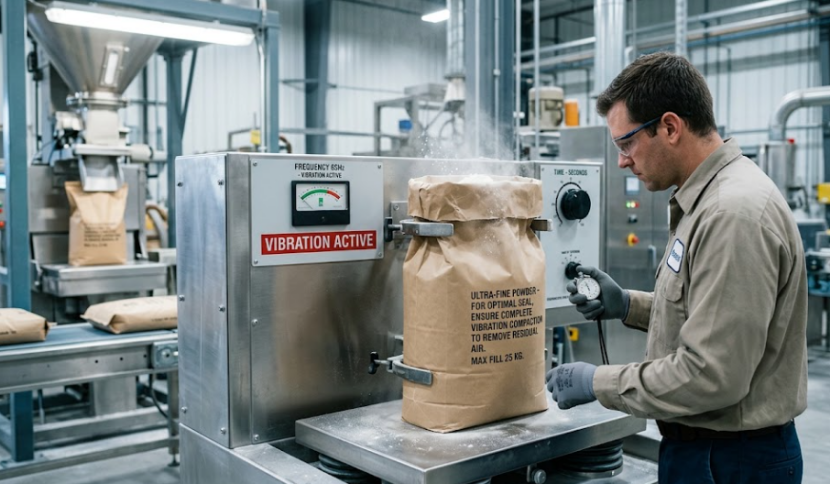
When ultra-fine powders are filled into bags, a large amount of air is trapped between the particles. The material remains in a loose, fluffy state, with a volume more than 20% greater than its actual settled volume. If sealed directly, the residual air slowly escapes during storage and transportation, creating negative pressure inside the bag or forcing the seal open from within. This is exactly why a "perfectly sealed" bag can still leak.
II. The Role of Vibration Compaction
The purpose of the high-frequency vibration compaction unit is to expel the air between particles before sealing, allowing the material volume to shrink to a stable state. Only then is the bag sealed—with no excess air inside, the seal will not be subjected to changing forces during storage and transport. However, if the vibration parameters are set incorrectly—frequency too low, duration too short, or not adjusted when material properties change—the air will not be fully removed, and leakage becomes inevitable.
III. Tuning Recommendations
Re-validate the vibration parameters every time you switch materials: after filling, leave the bag unsealed, vibrate it for different durations, and measure the material height inside the bag. Find the shortest time after which the height no longer decreases, and set that as the standard vibration duration for that material. Also, check that the vibration table's mounting bolts are not loose. Otherwise, vibration energy will be absorbed and fail to transmit effectively to the material.


