

| Contact Us |
| Name:colin |
| Email:colin@xhhjtech.com |
| T e l:+86 18602602237 |
Crusher Discharge Too Coarse or Too Fine? Check These 5 Parameters First
A crusher is designed to break down agglomerated material into the correct particle size. When the discharge size is incorrect, the immediate reaction is often to replace the screen. However, if replacing the screen does not resolve the issue, check these five parameters instead.
Parameter 1: Shaft Speed
Using the same screen, faster rotation yields finer output, while slower rotation yields coarser output. If a misconfigured VFD or a slipping belt causes the shaft speed to drop, the material will come out too coarse. Measure the main shaft speed with a tachometer. If it strays more than 5% from the setpoint, adjust it.
Parameter 2: Air Purge Seal Pressure
If air seal pressure is set too high, the injected air creates strong internal drafts. This suspends fine powder inside the chamber, preventing it from falling through the screen in time and resulting in an overly coarse discharge. The airflow also dilutes material density, reducing overall crushing efficiency. Check the pressure regulator to ensure it stays within the specified range and dial it down if necessary.
Parameter 3: Screen Mesh / Aperture Size
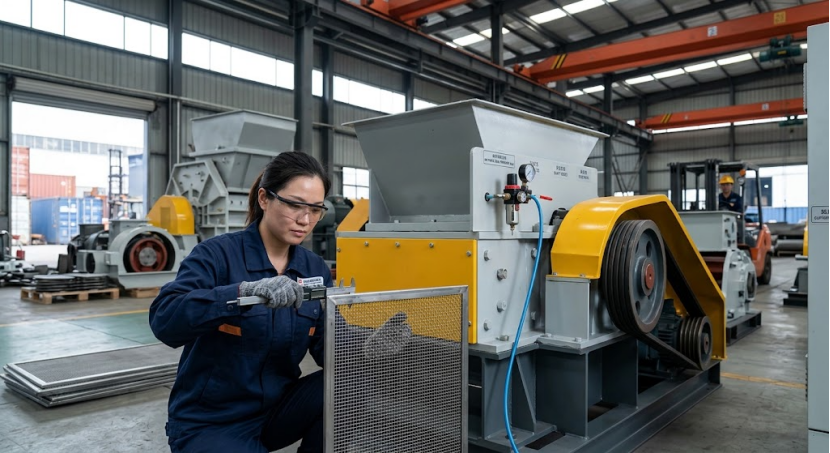
This is the most direct factor, yet it's frequently overlooked. Never assume a new screen matches what you ordered. Mislabeling or supplier shipping errors happen and a screen marked 0.5 mm might actually measure 0.8 mm. Always measure the actual aperture size using a vernier caliper to double-check.
Parameter 4: Feed Rate
Feeding too fast causes material to back up in the chamber. The crushed powder can't discharge in time, so it gets recrushed over and over, making the output too fine. Feeding too slowly leaves the material inside for too little time, making the output too coarse. The ideal feed rate is reached when you achieve a steady discharge rate and a stable motor current.
Parameter 5: Cutter Wear
Blades grow dull with prolonged use, lowering crushing efficiency and causing a gradual shift toward coarser material. Check the cutting edges for visible rounding or nicks, then resharpen or replace them as needed. Because blade wear is a gradual process, tracking and logging particle size over time allows you to predict blade replacement before a complete breakdown occurs.


