

| Contact Us |
| Name:colin |
| Email:colin@xhhjtech.com |
| T e l:+86 18602602237 |
Where Do Dust Explosion Risks Come From in Powder Workshops? Five Elements That Must Be Controlled
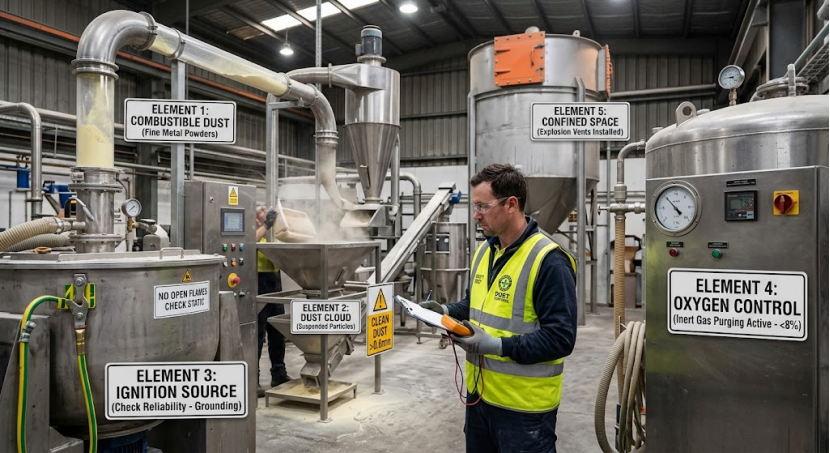
The biggest safety risk in a powder workshop is a dust explosion. A dust explosion requires five conditions to be met at the same time. Control any one of them and the explosion will not happen.
Element 1: Combustible Dust
This is the material basis for an explosion. Common combustible dusts include: metal powders (aluminum powder, magnesium powder, titanium powder), organic dusts (flour, starch, sugar powder, milk powder), plastic powders (polyethylene, polypropylene, PVC)and pharmaceutical powders. How violent the explosion is depends on particle size, concentrationand ignition energy. The finer the particle size, the higher the concentration and the lower the ignition energy, the more violent the explosion.
Element 2: Dust Cloud
A dust cloud suspended in the air is the direct condition for an explosion. Dust clouds usually form during operations such as feeding, discharging, cleaning and conveying. A dust layer settled on the floor or equipment surface will not explode directly, but once it is disturbed and thrown into the air to form a dust cloud, it can be ignited. When the dust layer in the workshop is thicker than 0.8 mm, it needs to be cleaned up in time.
Element 3: Ignition Source
Common ignition sources include: electrostatic discharge, electrical sparks, friction sparks, hot surfaces, open flames and spontaneous combustion. Among these, electrostatic discharge is the most hidden and also the most common ignition source. Powder generates static electricity through friction during conveying and sieving. If there is no reliable grounding, the static electricity will build up and discharge once it reaches a certain level, and the energy is enough to ignite the dust cloud.
Element 4: Oxygen
Oxygen in the air is the combustion-supporting agent for an explosion. Controlling oxygen concentration is one of the important means of explosion prevention. For especially dangerous materials, nitrogen inerting protection can be used. Filling the equipment with nitrogen to reduce the oxygen concentration below the explosion limit. Normally, the oxygen content is required to be below 8 to 10 percent.
Element 5: Confined Space
Dust explosions usually happen in confined spaces, such as pipes, silos, mixers and dust collectors. In a confined space, pressure cannot be released quickly, the explosion pressure rises sharply, making the destructive power far greater than in an open space. Installing explosion vent panels or explosion isolation valves on the equipment can direct the explosion pressure in a safe direction.
Among the five elements, combustible dust and confined spaces usually cannot be eliminated and oxygen control requires the support of an inerting system. What can truly be controlled in daily management is the formation of dust clouds and the elimination of ignition sources. Keeping the workshop clean, the equipment sealed, the grounding reliable, and hot work strictly controlled will reduce the risk of dust explosion to the lowest level.


