

| Contact Us |
| Name:colin |
| Email:colin@xhhjtech.com |
| T e l:+86 18602602237 |
Same Zero-Gravity Mixer but Why Do Some Get Perfect Blends in 3 Minutes While Others Still Can't Get It Right After 10mn? What's the Difference?
The double paddle zero-gravity mixer is highly efficient, most materials reach uniformity in about three minutes. But some users find that after ten minutes of mixing, their samples still fail the uniformity test and they start to suspect the equipment is faulty. The machine is the same, the paddle speed hasn't changed, the difference comes down to the operator.
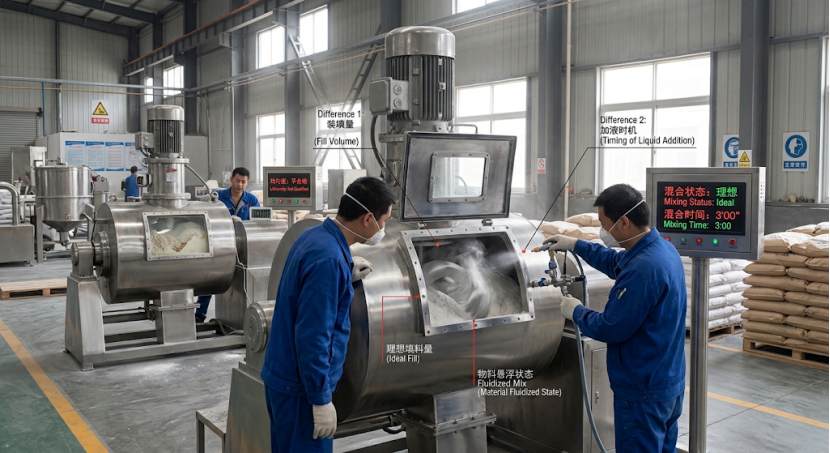
Difference 1: Fill volume
The correct fill volume is when the material just reaches the centerline of the two paddle shafts. If you fill too little, the material won't be thrown up and won't achieve the zero-gravity mixing state. If you fill too much, the paddles are submerged and the mixing degrades to localized stirring. The optimal fill rate is 40% to 70% of the effective volume of the mixing chamber. Outside this range, the mixing performance drops off significantly. If the fill volume is off, extending the mixing time won't get you to a passing result.
Difference 2: Timing of liquid addition
The correct way is to add all the powder first and start the mixer, letting the powder blend evenly and reach a suspended fluidized state, then slowly spray in the liquid in atomized form. The wrong way is to pour in the liquid at the very beginning, the powder will quickly absorb the liquid and form wet agglomerates. Once these lumps form, they're very difficult to break apart again, and the final product will end up with lots of color spots or hard chunks with uneven composition. The timing of liquid addition determines whether the powder-liquid mixing succeeds or fails.
Difference 3: Mixing time
The correct approach is to find the shortest time required for that specific material to reach uniformity, and use that as the standard. The wrong approach is to assume that "longer mixing means better uniformity." Once a zero-gravity mixer reaches the uniformity point, continuing to mix won't improve the results. In some cases, it can even cause issues like static buildup or over-grinding due to excessive friction between particles. The optimal mixing time for each material needs to be determined through testing, not guessed by feel.


