

| Contact Us |
| Name:colin |
| Email:colin@xhhjtech.com |
| T e l:+86 18602602237 |
How Pneumatic MixerDetermine the Loading Capacity ? From Effective Volume to Optimal Fill Rate Calculation
The loading capacity of a pneumatic mixer is the operating parameter that most directly affects mixing performance, but many users simply operate based on "roughly how much to load" without precise calculation. If the loading capacity is too much or too little, mixing efficiency will drop significantly.
Step 1: The nominal volume of a pneumatic mixer is the geometric volume of the cylinder, but the effective volume must deduct the dead zone above the air distribution plate, the space occupied by the top filter and the reserved space required for material boiling and expansion. The effective volume is usually 70% to 80% of the nominal volume. Confirm the nominal volume on the equipment nameplate and calculate the effective volume.
Step 2: The bulk density of a material refers to the mass per unit volume of the material in its natural piled state, expressed in kilograms per liter or tons per cubic meter. Bulk density is different from the true density of a material. True density is the density after excluding voids between particles, while bulk density includes voids between particles and closed pores within particles. Bulk density is a key parameter for calculating loading mass and must be measured using a standard method, not estimated by experience.
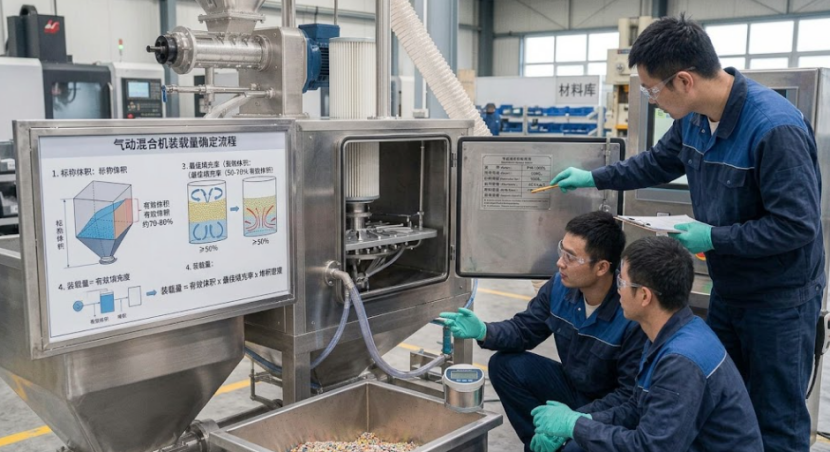
Step 3: The optimal fill rate of a pneumatic mixer is 50% to 70% of the effective volume. When the fill rate is below 50%, the material layer is too thin, the airflow short-circuits directly, and the material is blown to the top and then falls straight down, unable to form a stable circulating turnover. When the fill rate is above 70%, the material layer is too thick, the bottom airflow struggles to penetrate the entire material layer and the top material does not turn over sufficiently. For materials with good flowability and low bulk density, the fill rate should be taken at the upper limit. For materials with poor flowability and high bulk density, the fill rate should be taken at the lower limit.
Step 4: Loading mass equals effective volume multiplied by optimal fill rate and then multiplied by bulk density. For example, for a pneumatic mixer with a nominal volume of 1,000 liters. If the effective volume is calculated as 800 liters, the optimal fill rate is taken as 60%and the material bulk density is 0.5 kg per liter, then the loading mass is 800 multiplied by 0.6 multiplied by 0.5, which equals 240 kg.
Step 5: After calculating the theoretical loading mass, conduct actual mixing tests and observe the mixing performance and current changes. If the mixing time is significantly prolonged or the current is high, it indicates that the loading amount is too much and it should be appropriately reduced. If the mixing time is normal but the uniformity is unstable, it indicates that the loading amount is too little, and it should be appropriately increased. Theoretical calculation provides the initial value and actual verification provides the final value. Neither step can be omittedand the practice of loading directly by experience is not advisable.


