

| Contact Us |
| Name:colin |
| Email:colin@xhhjtech.com |
| T e l:+86 18602602237 |
What Are the Differences Between Powder Equipment on Food Additive Production Lines and Pharmaceutical Production Lines?
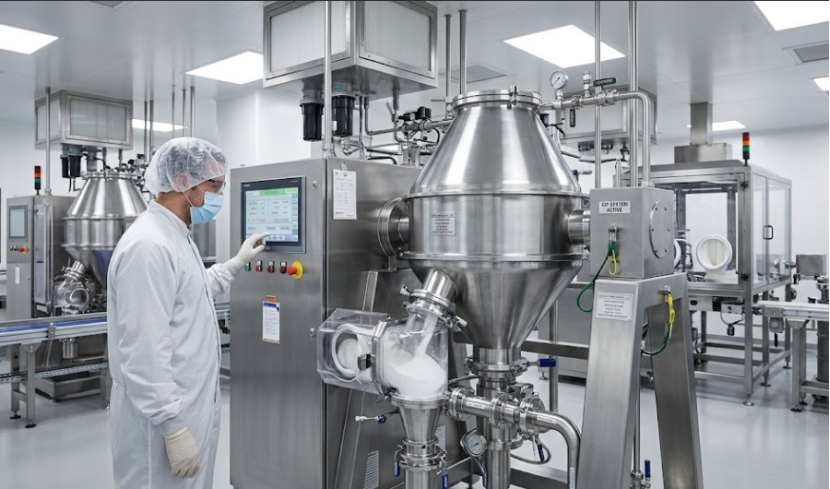
Food additive production lines and pharmaceutical production lines both handle powders and require cleanliness and precision, but the focus of equipment configuration is clearly different. The core of pharmaceutical lines is GMP compliance and cross-contamination control, while the core of food additive lines is high capacity, corrosion resistance and cleaning convenience. These are 6 more specifically differences:
Material Requirements
Pharmaceutical lines usually require 316L stainless steel, with stronger corrosion resistance and higher surface finish. Food additive lines commonly use 304 stainless steel and only upgrade to 316L for acidic or salt-containing materials. Food lines pay more attention to whether the material resists food acid and alkali corrosion, while pharmaceutical lines pay more attention to whether the material releases ions that contaminate drugs.
Cleaning Method
Pharmaceutical lines require support for CIP and cleaning validation. Equipment must be able to drain completely, have no dead corners and be disassemblable. Food additive lines also require cleaning, but usually do not require strict cleaning validation, it place more emphasis on cleaning speed and convenience. Food lines commonly use high-pressure water guns for rinsing, while pharmaceutical lines prohibit direct water rinsing of electrical parts.
Dust Control Requirements
Pharmaceutical lines have extremely strict dust control, especially for highly active drugs, requiring negative-pressure isolation or glove box operation. Dust control in food additive lines is mainly for workshop environment and explosion prevention. Combustible dusts such as sugar powder, starch and flour require explosion-proof design.
Capacity Scale
Pharmaceutical lines usually have smaller batches and more product varieties, so equipment tends to emphasize flexibility and changeover convenience. Food additive lines have large batches and relatively fixed varieties, so equipment tends to emphasize high capacity and continuous operation. A mixer used for food additives may have five to ten times the volume of a mixer used for pharmaceuticals.
Explosion-Proof Requirements
Sugar powder, starch, flour, cocoa powder and other materials in food additives are combustible dusts. Explosion-proof requirements are stricter than for most drugs. Feeding stations, mixers and dust collectors on food additive lines usually need to be equipped with explosion vent panels, explosion isolation valves, and electrostatic grounding systems. In pharmaceutical lines, only a few highly active or solvent-containing materials have explosion-proof requirements.
Cleaning Agent Selection
Pharmaceutical lines commonly use purified water or water for injection for cleaning, with clear standards for residue limits. Food additive lines commonly use drinking water plus food-grade cleaning agents for cleaning. Residue standards are relatively looser, but there are requirements for the food safety of the cleaning agent itself.
The two types of lines also have commonalities: both require enclosed equipment, accurate metering and data recording. However, the focus is different, the priority ranking during selection is also different. Only by understanding these differences can you choose the most suitable equipment for a food additive production line, rather than copying pharmaceutical line configurations and spending money unnecessarily.


